Who First Discovered Jesus’s Tomb Was Empty?
This article examines strictly the consistency or otherwise of the four canonical (official) gospels, which all Christian denominations consider infallible (i.e., God’s word). It does not question whether Jesus actually died, whether he was entombed, or whether he rose from the dead: it assumes the gospel narrative, as is. Following is what each of the canonical gospels says; I shall quote the King James Version of the gospels faithfully, of course, but the reader is welcome to verify.
The Gospel according to Mark
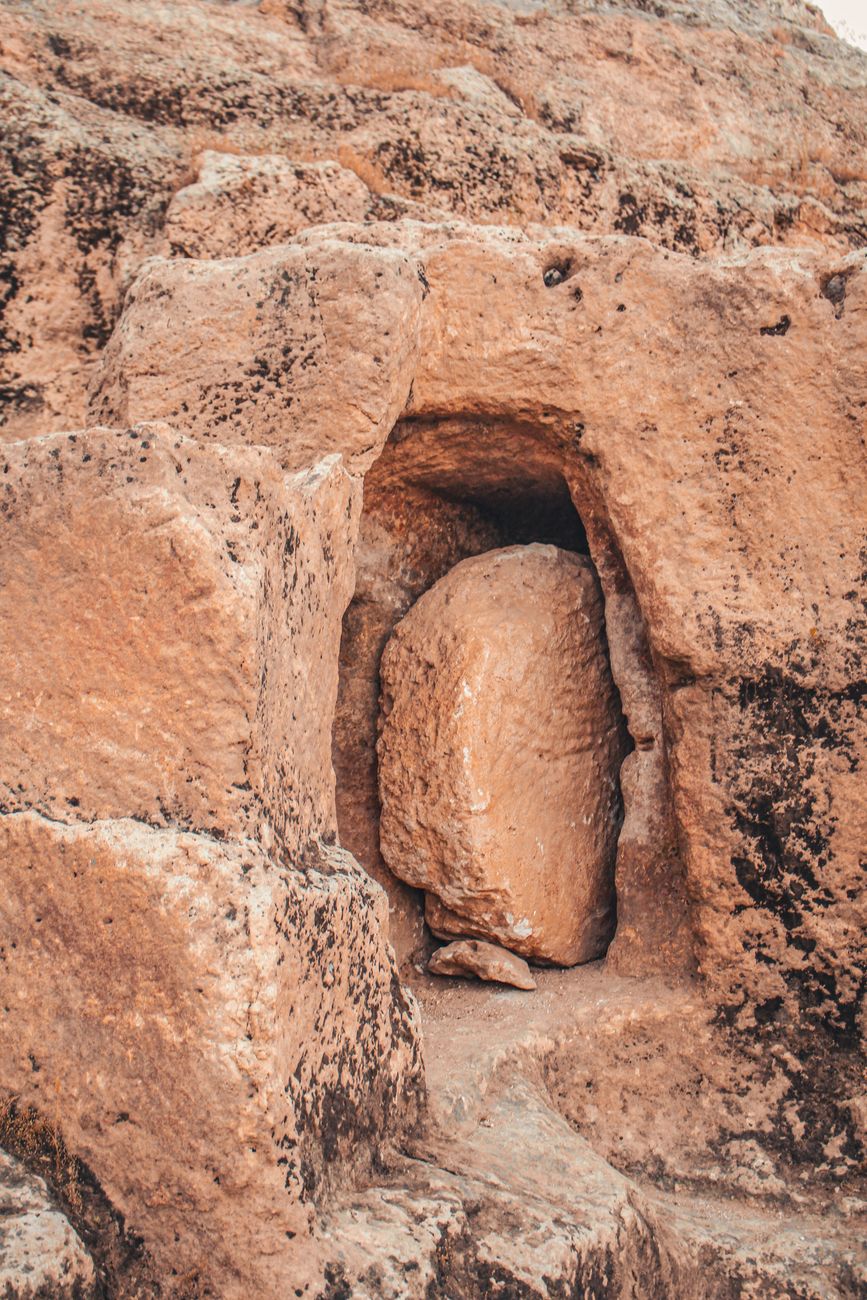
In this gospel (16:1-6), which was the first of the four canonical gospels written (around 70 CE), we read, “When the Sabbath [Saturday] was past, Mary Magdalene, and Mary the mother of James, and Salome, had bought sweet spices, that they might come and anoint him [Jesus]. And very early in the morning the first day of the week [Sunday], they came unto the sepulchre [tomb] at the rising of the sun. And they said among themselves, ‘Who shall roll us away the stone from the door of the sepulchre?’ And when they looked, they saw that the stone was rolled away: for it was very great. And entering into the sepulchre, they saw a young man [angel] sitting on the right side, clothed in a long white garment; and they were affrighted. And he saith unto them, ‘Be not affrighted: ye seek Jesus of Nazareth, which was crucified: he is risen; he is not here: behold the place where they laid him.’” (KJV)
So, according to the evangelist Mark, three women were the first to find out that Jesus’s dead body was not in the tomb where he was buried: Mary Magdalene, Mary the mother of James, and Salome.
The Gospel according to Matthew
In this gospel (28:1-6), which was written at least a decade later—in the 80s CE—we read, “In the end of the Sabbath, as it began to dawn toward the first day of the week, came Mary Magdalene and the other Mary [refers to “the mother of James and Joses” in 27:56] to see the sepulchre. And, behold, there was a great earthquake: for the angel of the Lord descended from heaven, and came and rolled back the stone from the door, and sat upon it. His countenance was like lightning, and his raiment white as snow: and for fear of him the keepers [guards] did shake, and became as dead men. And the angel answered and said unto the women, ‘Fear not ye: for I know that ye seek Jesus, which was crucified. He is not here: for he is risen, as he said. Come, see the place where the Lord lay.’” (KJV)
So, according to the evangelist Matthew, two, women first witnessed Jesus’s tomb was empty: Mary Magdalene and Mary the mother of James and Joses (Greek variant for Joseph). Admittedly, this latter Mary could have been the same as Mary the mother of James mentioned in Mark’s gospel; but Salome is never mentioned by Matthew, even though most biblical scholars agree that Matthew used Mark’s gospel as a template.
The Gospel according to Luke
In this gospel (24:1-11), which was written in the 90s CE, we read, “Now upon the first day of the week, very early in the morning, they [refers to “the women … which came with him (Jesus) from Galilee” in 23:55] came unto the sepulchre, bringing the spices which they had prepared, and certain others with them. And they found the stone rolled away from the sepulchre. And they entered in, and found not the body of the Lord Jesus. And it came to pass, as they were much perplexed thereabout, behold, two men [angels] stood by them in shining garments: and as they were afraid, and bowed down their faces to the earth, they said unto them, ‘Why seek ye the living among the dead? He is not here, but is risen: remember how he spake unto you when he was yet in Galilee, saying, “The Son of man [here refers to Jesus] must be delivered into the hands of sinful men, and be crucified, and the third day rise again.”’ And they remembered his words, and returned from the sepulchre, and told all these things unto the eleven [apostles], and to all the rest. It was Mary Magdalene and Joanna, and Mary the mother of James, and other women that were with them, which told these things unto the apostles. And their words seemed to them as idle tales, and they believed them not.” (KJV)
So, according to the evangelist Luke, at least five women first witnessed Jesus’s empty tomb: Mary Magdalene and Mary the mother of James are consistent with Mark and Matthew, but Joanna replaces Salome in Mark’s gospel: despite, according to biblical scholars, Luke’s also using Mark’s gospel as a template. Mark’s, Matthew’s, and Luke’s gospels are termed by biblical scholars as the Synoptic Gospels—meaning, they exhibit the same viewpoint (syn-optic).
The Gospel according to John
In this gospel (20:1-10), written in the 100s CE, we read, “The first day of the week cometh Mary Magdalene early, when it was yet dark, unto the sepulchre, and seeth the stone taken away from the sepulchre. Then she runneth, and cometh to Simon Peter, and to the other disciple, whom Jesus loved, and saith unto them, ‘They have taken away the Lord out of the sepulchre, and we know not where they have laid him.’ Peter therefore went forth, and that other disciple, and came to the sepulchre. So they ran both together: and the other disciple did outrun Peter, and came first to the sepulchre. And he stooping down, and looking in, saw the linen clothes lying; yet went he not in. Then cometh Simon Peter following him, and went into the sepulchre, and seeth the linen clothes lie, and the napkin, that was about his head, not lying with the linen clothes, but wrapped together in a place by itself. Then went in also that other disciple, which came first to the sepulchre, and he saw, and believed.” (KJV)
So, the evangelist John has a totally different account from the Synoptic Gospels: besides Mary Magdalene, he includes two men (Peter and the disciple whom Jesus loved) as well!
Incidentally, the so-called ‘beloved disciple’ seems to be also the author of the ‘Gospel according to John’ whose name we don’t really know for sure: the evangelist known to us Christians as ‘John’ adds, “This is the [beloved (see 21:7)] disciple which testifieth of these things, and wrote these things: and we know that his testimony is true.” (21:24) Indeed, a few scholars even believe that the ‘beloved disciple’ is, in fact, Mary Magdalene writing as a male author. Admittedly, the above quotes seem to contradict this concept—but that’s another story.
Summary
So, Mark says there were three women who first witnessed the empty tomb, Matthew says it was two women, Luke says there were at least five women, and finally John says it was one woman who immediately brought two men to see for themselves.
Moreover, Mark and Matthew say there was one angel at the tomb site, Luke says there were two angels, and John implies there were none.
Needless to mention, perhaps, the above textual contradictions and inaccuracies preclude the possibility of the Bible’s infallibility: God, by definition, doesn’t make mistakes—not even small ones. With contradictions in the Bible’s own text, one or more (if not all) of its versions must be wrong!
The Common Factor
So, what’s going on, here? Looking closely at all this mess, one finds one common factor: all four gospels say that Mary Magdalene was the one or among those who first discovered the empty tomb. In my opinion, therefore, the truth is that it was Mary Magdalene alone who first discovered the empty tomb as indeed John’s gospel tells us, but all four evangelists invented other witnesses: and that’s why they disagreed. So why did the evangelists choose to be somewhat dishonest? In the old days, there were very few ways of cross-checking facts, not to mention that all four gospels were anonymously written by unknown people at different times and different places. It was the Christian Church that attributed them to Mark, Matthew, Luke and John toward the end of the second century CE. So, they figured it was safe enough to take advantage of the situation to kind of ‘help’ God.
The Old Testament
In the ‘Book of Deuteronomy’ (19:15), we read, “One witness shall not rise up against a man for any iniquity, or for any sin, in any sin that he sinneth: at the mouth of two witnesses, or at the mouth of three witnesses, shall the matter be established.” (KJV) In other words, in Judaism, the testimony of a single person was not worth much, if anything; and Jesus’s resurrection from the dead was at stake here. Naturally, that was a big deal to the early Christians.
Conclusion:
Consequently, the first three evangelists added one or more female witnesses to satisfy Deuteronomy. Moreover, the testimony of women was practically worthless in those days; except, perhaps among Christians. For example, in (Saint) Paul’s Galatians (3:28), written in the early 50s CE, we read, “There is neither Jew nor Greek, there is neither bond [slave] nor free, there is neither male nor female: for ye are all one in Christ Jesus.” (KJV) But things took a 180º turnaround among Christian communities at the turn of the second century CE: one need only compare Paul’s seven undisputedly authentic letters (i.e., Romans, 1st & 2nd Corinthians, Galatians, Philippians, 1st Thessalonians, and Philemon) all written in the 50s CE, with the three pastoral letters (i.e., 1st & 2nd Timothy and Titus) written posthumously by ‘pseudo Paul’ around 100 CE. For example, in First Timothy (2:11-12), we read, “Let the woman learn in silence with all subjection. But I suffer not a woman to teach, nor to usurp authority over the man, but to be in silence.” (KJV) So, the last of the canonical evangelists, John, conveniently, added the testimony of two men.
To me, however, the discovery of the empty tomb by a single woman bears more of the ring of truth!
References:
The Holy Bible: King James Version (KJV). Oxford, UK, 1769.
Author’s Books
For those readers who might be interested in buying any of my books, following are the publisher’s (iUniverse’s) links. If you find the hard copies expensive, the soft copies are only US$3.99 each. Should you decide to buy any of my books, kindly also remember to leave a review after reading it (2 or 3 sentences would do).
(1) Is God a Reality?—A Scientific Investigation:
https://www.iuniverse.com/en/bookstore/bookdetails/740913-Is-God-a-Reality,
(2) Is the Bible Infallible?—A Rational, Scientific, and Historical Evaluation:
https://www.iuniverse.com/en/bookstore/bookdetails/792987-is-the-bible-infallible, and
(3) Faith and Reason: Disturbing Christian Doctrines:
https://www.iuniverse.com/en/bookstore/bookdetails/812598-faith-and-reason.
My books are also available on Amazon, Barnes and Noble, Indigo-Chapters, etc.

