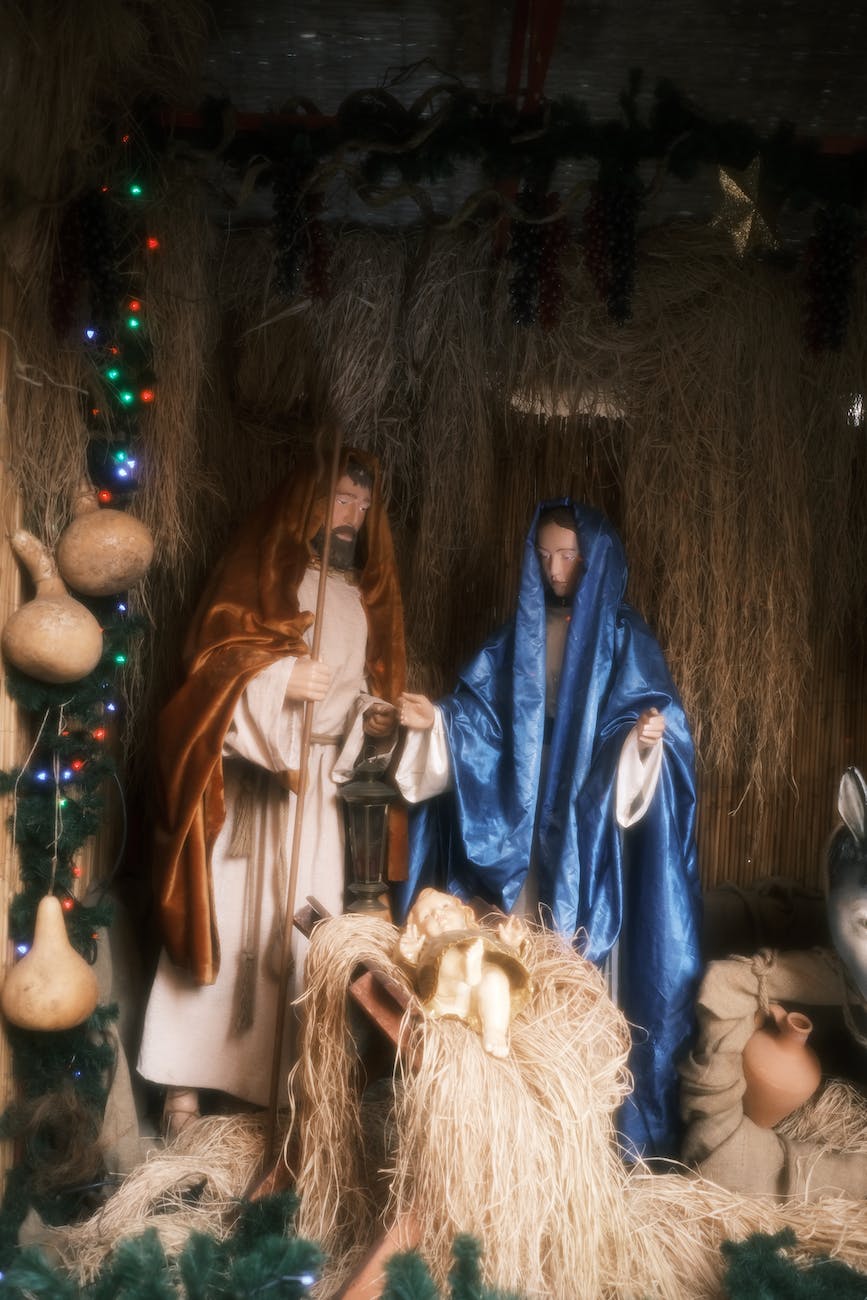
Christmas is a yearly Christian celebration commemorating Jesus’s birth. Reading the various New Testament accounts, one notices not only textual contradictions (see ‘Flight into Egypt’ in my article ‘Bible Contradictions (New Testament)’) but also scientific and historical anomalies that I’d like to share with the reader of this article.
The ‘star,’ claimed by the evangelist Matthew to have led the Magi to Jesus, seems to be no more than a contemporaneous folklore myth, and the ‘census,’ claimed by the evangelist Luke to have triggering Joseph’s and Mary’s journey from Nazareth to Bethlehem, doesn’t seem to have ever happened historically. So, in this article I show that, unfortunately, there’s not much truth left to our Christmas stories!
I shall not cheat: I shall only quote the New Testament itself and biblical scholars to show this—biblical anomalies/discrepancies/details most believers fail to notice. I’m not trying to undermine Christmas: I actually love Christmas; I’m simply looking for the truth because I truly believe that God is always on truth’s side—no matter what.
Matthew’s Gospel
In Matthew’s gospel, we read of a ‘star’ that led the ‘wise men’ to new-born baby Jesus:
“When Jesus was born in Bethlehem of Judaea [Judah] in the days of Herod the king, behold, there came wise men from the east to Jerusalem, saying, ‘Where is he that is born King of the Jews? For we have seen his star in the east, and are come to worship him.’ … When they had heard the king, they departed; and, lo, the star, which they saw in the east, went before them, till it came and stood over where the young child was. … And when they were come into the house, they saw the young child with Mary his mother, and fell down, and worshipped him” (Matthew 2:1–2, 9, 11, KJV, emphasis mine)
The New American Bible comments on the phrase “his star” as follows: “It was a common ancient belief that a new star appeared at the time of a ruler’s birth.” (NAB, Matthew 2:2n)
[Note: According to ‘Wikipedia,’ the ‘New American Bible’ (NAB) translation “was carried out in stages by members of the ‘Catholic Biblical Association of America’ (CBA)” (Wikipedia s.v. “New American Bible,” accessed December 19, 2023) “Membership now numbers more than 1,200. Those who hold an advanced degree in biblical studies are eligible to be elected to membership, irrespective of any religious affiliation.” (Wikipedia s.v. “Catholic Biblical Association,” accessed December 19, 2023) I’d like to point out, therefore, that the ‘New American Bible’ isn’t just the opinion of a single or a handful of biblical scholars. It also advertises the book, “This modern translation was prepared by over 50 scholars.”]
Incidentally notice that the star allegedly indicated a “house,” not a cave or an animal barn, as portrayed in Christmas cards. My guess, their home was in Nazareth, not in Bethlehem.
Besides, a star is light-years away (1 light-year ~ 10 trillion km ~ 6 trillion mi), how could it possibly “stay over” or indicate a particular house? How could it “go before them” and lead them in their journey? Unless it was a ‘comet’ (or ‘shooting star’) leaving a trail behind it that one could somehow follow. In fact, journalist and television host Bill O’Reilly and coauthor Martin Dugard, in their book Killing Jesus, have the following footnote regarding the ‘star’ the wise men supposedly followed to Jerusalem and subsequently to Bethlehem:
“In 1991, The Quarterly Journal of the Royal Astronomical Society noted that Chinese astronomers had observed a long-tailed slow-moving comet in their skies during March of 5 B.C.
This sui-hsing, or ‘star,’ hung in the Capricorn region for more than seventy days. This same comet would have been visible in the skies over Persia, home of the Magi [astrologers/wise men], in the hours just before dawn. Due to the earth’s orbital motion, the comet’s light would have been directly in front of the Magi during their journey—hence, they would have truly followed the star.” (O’Reilly & Dugard, p. 15 n. 2)
5 BCE. is most probably the year Jesus was born (see below). Although I find this very interesting, I still think that the concept of an important person’s birth being announced by means of a star is a myth: stars take millions of years to form.
Now, granting that it was a comet, rather than a star, and even assuming the wise men could follow its luminous tail, a comet could not possibly indicate the house where the child Jesus was: it’s too high up—if the reader knows anything about ‘parallax.’ Presumably, it did not fall on the house otherwise it would have burnt it. And when was it that anyone saw a comet stop in midair: “stand over,” the house as the gospel says? One needs a lot of imagination to believe all the details described in this account.
Luke’s Gospel
In Luke’s gospel, we read about a universal Roman census at the time of Jesus’s birth:
“It came to pass in those days, that there went out a decree from Caesar Augustus that all the [Roman] world should be taxed. (And this taxing [enrolling (NAB)] was [the (NAB)] first made when Cyrenius [Quirinius (NAB)] was governor of Syria.) And all went to be taxed, every one into his own city. And Joseph also went up from Galilee, out of the city of Nazareth, into Judaea [Judah], unto the city of David, which is called Bethlehem; (because he was of the house and lineage of David). (Luke 2:1–4, KJV, emphasis mine)
Notice the phrase “all the world” in this passage, which, in those days, was synonymous to the Roman Empire. The problem with this passage is that there’s no record of such a universal decree by Caesar Augustus.
The New American Bible comments here: “Although universal registrations of Roman citizens are attested in 28 B.C., 8 B.C., and A.D. 14 and enrollments in individual provinces of those who are not Roman citizens are also attested, such a universal census of the Roman world under Caesar Augustus is unknown outside the New Testament. Moreover, there are notorious historical problems connected with Luke’s dating the census when Quirinius was governor of Syria, and the various attempts to resolve the difficulties have proved unsuccessful. P. Sulpicius Quirinius became legate of Syria in A.D. 6–7 when Judea [Judaea or Iudaea, rather—see below] was annexed to the province of Syria. At that time, a provincial census of Judea [Judaea] was taken up.” (NAB, Luke 2:1–2n, emphasis mine)
Please notice the distinction between ‘universal’ and ‘provincial’ censuses in the above note: according to the New American Bible, contrary to what Luke’s gospel says, a provincial census of Judaea/Iudaea (see below) was taken—rather than a universal one.” Historians only know of three universal censuses of Roman citizens: that is, in 28 BCE, 8 BCE, and 14 CE; none under the Roman emperor Caesar Augustus, or in 6 CE—that is, if we exclude the New Testament writings. Publius Sulpicius Quirinius was appointed legate/governor of the province of Syria in 6 CE, at which time the Roman Syria’s ‘satellite’ province, Iudaea (consisting of Judea/Judah, Samaria just north of it & Idumea just south of it) was annexed to the Roman province of Syria.
Please distinguish between ‘Judea’ and ‘Judaea.’ Judaea was a Roman ‘province’; Judea was a main region or territory in that province, which gave the province its name.
According to Wikipedia: “Judaea (Latin: Iudaea …) was a Roman province from 6 to 132 CE, which incorporated the … regions of Judea [Judah], Samaria, and Idumea ….” (Wikipedia: “Judaea (Roman Province),” accessed December 19, 2023)
Notice the slight spelling difference between ‘Judaea’ (or Iudaea) and ‘Judea’ (or Judah/Juda). (The Romans had no ‘J’ in their alphabet; they used ‘I’ instead.)
“In 6 AD, Emperor Augustus deposed the ethnarch Herod Archelaus and united Judea [Judah], Samaria and Idumea into the Roman province of Judea [Judaea, rather]; such province was placed under the direct authority of the Legate of Syria Publius Sulpicius Quirinius.” (Wikipedia: “Roman Syria,” accessed December 19, 2023”)
Now, Nazareth (where Jesus’s parents lived), was in Galilee. Galilee was in the north of Israel while Judea (or Judah) was in the south; so, Galilee was not part of the Roman province of Judaea/Iudaea. (Wikipedia: “Galilee,” accessed December 19, 2023) In other words, the fact that there was a census of Judaea does not imply, indeed excludes, that there was also a census of Galilee.
Common Era
To put things in the right perspective in what follows (for the benefit of the reader who might not be aware of it), the Common Era (CE/AD) was originally thought of in the sixth century CE and intended to start at the birth of Jesus.
According to Wikipedia, “The idea of numbering years beginning from the date he believed to be the date of birth of Jesus, was conceived around the year 525 [CE] by the Christian monk [and biblical scholar] Dionysius Exiguus.” (Wikipedia: “Common Era,” accessed December 19, 2023”)
Unfortunately, however, he made a slight mistake: so Jesus not born in 1 CE, as intended. It so happened that this small error in calculation persisted over the centuries—it was never corrected.
Jesus’s Birth Year
According to Wikipedia, “The date of birth of Jesus is not stated in the gospels or in any historical sources, but most biblical scholars generally accept a date of birth between 6 BC and 4 BC, the year in which King Herod died.” (Wikipedia: “Date of Birth of Jesus,” accessed December 19, 2023”)
In other words, Jesus’s birth date is most probably around 5 BCE (as mentioned above). This makes Quirinius’s census, which happened in 6 CE, too late—out by at least ten-odd years since it supposedly happened just before Jesus was born (from 5 BCE to 6 CE is 5+6 = 11 years).
Quirinius’s Census
The New American Bible, commenting further on the above passage in Luke 2:1–4, states,
“If Quirinius had been legate of Syria previously, it would have to have been before 10 B.C. because the various legates of Syria from 10 B.C. to 4 B.C. (the death of [King] Herod), are known, and such a dating of an earlier census under Quirinius would create additional problems for dating the beginning of Jesus’ ministry (Luke 3:1, 23). A previous legateship after 4 B.C. (and before A.D. 6) would not fit with the dating of Jesus’ birth in the days of [King] Herod (Luke 1:5; Matthew 2:1)” (NAB, Luke 2:1–2n)
Let me explain this note gradually. Here, the New American Bible points out that if we postulate Quirinius was governor of Syria before Jesus was born (i.e., besides his 6–12 CE known legateship), it would have had to be prior to 10 BCE because we happen to know all the governors of Syria from 10 BCE to the death of King Herod the Great, estimated by historians in 4 BCE. However, as we shall see presently, dating the census prior to 10 BCE would not jibe with Luke’s gospel itself not to mention Matthew’s gospel as well. How does this follow? Let’s first look at a few politico-geographical and historical facts around the turn of the first century CE before we delve into it.
Political Geography
In Jesus’s time, west of the River Jordan, Israel was divided in three regions: Galilee (which included Nazareth) in the north, Samaria in the middle, and Judea/Judah (which included Jerusalem and Bethlehem) in the south; east of the River Jordan, it was divided in four regions: Iturea, Trachonitis, and the Decapolis (Greek for ‘ten cities’) in the north, and Perea in the middle (i.e., beside Samaria). (NAB, p. 12a)
History
The Romans made Herod the Great king of all Israel in 37 BCE. When he died in 4 BCE, his kingdom was divided among his four children, who were subsequently called ‘tetrarchs,’ from the Latin ‘ruler of a fourth part’ of a country or province. He is not to be confused with his son, Herod Antipas, who became “tetrarch of Galilee and Perea” after his father’s death. (Wikipedia: “Herod Antipas,” accessed December 19, 2023)
Main Theme
Now, as I was saying, if one were to postulate that Quirinius was governor of Syria at some other time (i.e., besides the known 6–12 CE), the New American Bible contends that it would have had to be prior to 10 BCE because all the governors of Syria between 10 BCE and the death of King Herod in 4 BCE are known. However, 10 BCE would have been too early for the time of Jesus’s birth as it is given in Luke’s gospel. To see this, let’s follow the citations given by the New American Bible’s note above.
Luke introduces John the Baptist’s and Jesus’s ministries as follows: “Now in the fifteenth year of the reign of Tiberius Caesar, Pontius Pilate being governor of Judaea, and Herod [Antipas] being tetrarch of Galilee [& Perea], and his brother Philip tetrarch of Ituraea and of the region of Trachonitis, and Lysanias the tetrarch of Abilene [in Syria], Annas and Caiaphas being the high priests, the word of God came unto John the son of Zacharias in the wilderness. … And Jesus himself began to be about thirty years of age, being (as was supposed) the son of Joseph, which was the son of Heli ….” (Luke 3:1–2, 23, KJV, emphasis mine)
From these two verses, one can deduce the year of Jesus’s birth according to Luke’s gospel. We know that Emperor Tiberius “reigned from AD 14 until [AD] 37”. (Wikipedia: “Tiberius,” accessed December 19, 2023). Since John the Baptist started his ministry after fifteen years of Tiberius’s reign, John must have started baptizing around 29 CE (14 CE + 15 years = 29 CE). Now, since Jesus started his ministry shortly after this, and Luke’s gospel says that he was then about 30 years old, this places Jesus’s birth date at, or shortly before 1 BCE (29 CE –30 years = –1 or 1 BCE). Consequently, the New American Bible argues that, assuming these two gospel statements are accurate, Quirinius couldn’t have conducted a census at the time of Jesus’s birth: Luke’s gospel would have a historical error of ten-odd years: from say 11 BCE (i.e., just prior to 10 BCE) to 1 BCE (11–1 = 10).
Summary
Summarizing, therefore, the alleged universal census in Luke’s gospel, if it ever happened, had to be either prior to 10 BCE because Quirinius was definitely not governor of Syria between 10 BCE and 4 BCE (the estimated year of King Herod’s death) or else after 6 CE when, we know, Quirinius became governor of Syria. But these dates are either too early or too late for the year of Jesus’s birth.
(1) If we follow the biblical scholars’ estimate for Jesus’s birth (i.e., 5 BCE), after 6 CE is ten-odd (5 BCE + 6 CE = 11) years too late for Jesus’s birth; while prior to 10 BCE (say, 11 BCE) is five-odd (11 BCE – 5 BCE = 6) years too early.
(2) If, on the other hand, we follow the estimate for Jesus’s birth from Luke’s gospel (i.e., 1 BCE), prior to 10 BCE is ten-odd (11 BCE – 1 BCE = 10) years too early; while after 6 CE is five-odd (1 BCE + 6 CE = 7) years too late.
Finally, the New American Bible points out, that postulating Quirinius was governor of Syria at some time in between 4 BCE and 6 CE would not have worked out either because it would contradict the statements by both Luke’s (1:5) and Matthew’s (2:1) gospels, that Jesus was born while King Herod the Great was still alive; but after 4 BCE King Herod was dead.
Let’s see exactly why. The New American Bible cites following two verses.
In Luke’s gospel, we read, “There was in the days of Herod, the king of Judaea, a certain priest named Zacharias, of the course [priestly division (NAB)] of Abia [Abijah (NAB)]: and his wife was of the daughters of Aaron, and her name was Elisabeth.” (Luke 1:5, KJV, emphasis mine)
And in Matthew’s gospel, we read, “Now when Jesus was born in Bethlehem of Judaea in the days of Herod the king, behold, there came wise men from the east to Jerusalem, saying, ‘Where is he that is born King of the Jews? For we have seen his star in the east, and are come to worship him.’” (Matthew 2:1–2, KJV, emphasis mine)
Notice the word “king,” not ‘tetrarch,’ in both the above quotes: so they are referring to King Herod the Great, not to Herod Antipas who was only a tetrarch not a king. From the first verse of this last quote, especially, we may safely conclude that King Herod was still alive when Jesus was born (at least according to the Gospels) because King Herod entertained these wise men.
So, a census between 4 BCE and 6 CE is out of the question because King Herod the Great would have been dead after 4 BCE: consequently, Jesus would have already been born, but the alleged census conducted by Quirinius took place before Jesus was born. In other words, it would contradict the above statements by two evangelists.
Therefore, the New American Bible concludes, “Luke may simply be combining Jesus’ birth in Bethlehem with his vague recollection of a census under Quirinius.” (NAB, Luke 2:1–2n)
Luke, writing his gospel around 85 CE (NAB, p. 96), was only going by some hazy memory of the provincial census Quirinius had conducted eighty-odd years earlier (i.e., in 6 CE).
Acts of the Apostles
As if this were not bad enough, in Acts, the same author of Luke’s gospel, writes there, “And [Pharisee Gamaliel] said unto them, ‘Ye men of Israel, take heed to yourselves what ye intend to do as touching these men [Jesus’s apostles]. For before these days rose up Theudas, boasting himself to be somebody; to whom a number of men, about four hundred, joined themselves: who was slain; and all, as many as obeyed him, were scattered, and brought to nought. After this man rose up Judas of Galilee in the days of the taxing [census], and drew away much people after him: he also perished; and all, even as many as obeyed him, were dispersed.” (Acts 5:35–37, KJV, emphasis mine)
The New American Bible comments here that, “The movement initiated by Theudas actually occurred when C. Cupsius Fadus was governor, A.D. 44–46.” (NAB, Acts 5:36–37n) Wikipedia confirms this: “At some point between 44 and 46 AD, Theudas led his followers in a short-lived revolt.” (Wikipedia: “Theudas,” accessed December 19, 2023”)
The New American Bible continues, “Luke’s placing of Judas the Galilean after Theudas and at the time of the census (see note on Luke 2:1–2) is an indication of the vagueness of his knowledge of these events.” (NAB, Acts 5:36–37n)
According to Wikipedia, “Judas of Galilee … was a Jewish leader who led resistance to the census imposed for Roman tax purposes by Quirinius in the Judaea Province in 6 CE.” (Wikipedia: “Judas of Galilee,” accessed December 19, 2023”)
Yet, Luke places Judas and the census after Theudas. In Acts, Luke is, therefore, some fifty-odd years (45 CE + 5 BCE = 50) off regarding the census that allegedly happened just prior to Jesus’s birth around 5 BCE: showing his very poor knowledge of historical facts. These are biblical contradictions that the ordinary believer easily misses unless he reads the Bible cover to cover very carefully.
Luke probably made some assumptions from his own recollections, or he confused the dates and the names, or (at worst) made everything up: any of which cases does not say much for the historical accuracy of the New Testament or the Bible.
So, in conclusion, why did Luke fabricate such a universal census? He had an agenda. He needed to conform to the birthplace of Jesus as was supposedly foretold by Old Testament scriptures. He wanted to show how Jesus was born in David’s city of Bethlehem, as the prophet Micah had declared:
“But thou, Bethlehem Ephratah, though thou be little among the thousands [clans (NAB)] of Judah, yet out of thee shall he come forth unto me that is to be ruler in Israel; whose goings forth [origins (NAB)] have been from of old, from everlasting.” (Micah 5:2, KJV)
Moreover, in any kind of Roman census (provincial or universal), Jesus’s family could have registered their names in their own village, Nazareth, or perhaps a nearby town in Galilee. According to Wikipedia, “A census was sometimes taken in the provinces …. The emperor sent into the provinces special officers called censitores to take the census.” (Wikipedia: “Roman Censor,” accessed December 19, 2023)
But Luke, somehow, needed to explain why Jesus’s family lived in the north of Israel (Nazareth) and yet Jesus was born in the far-away south (a journey of about a week in those days), in Bethlehem of Judah/Judea, as was supposedly foretold by the prophet Micah. According to the Catholic Ireland website, “It is about 120 Km from Narareth to Jerusalem and another 10 Km from Jerusalem to Bethlehem. (About 80 miles in all) If Mary had not been feeling very well it could have taken nearly a week to do the journey.” (Catholic Ireland: “Nazareth to Bethlehem,” accessed December 19, 2023) This corresponds roughly to 2 miles per hour for six hours a day.
Furthermore, only the ‘paterfamilias’ (Latin for ‘father of the family’ or head of the family) was obliged to appear personally and register all the members of his family. According to Wikipedia, “Every pater familias [Latin for ‘father of the family’] had to appear in person before the censors.” (Wikipedia: “Roman Censor,” accessed December 19, 2023)
In other words, heavily pregnant Mary did not have to do the seven day journey on a donkey (as she is often portrayed in Christmas cards). Would you have let Mary travel in her condition unnecessarily?
So, was Jesus born in Bethlehem? Maybe! The fact is we don’t really know, but it is unlikely. What we do know for sure is that Luke fabricated the circumstances that might have led up to its happening on vague recollections: but, unfortunately, it does not hold water—he never anticipated his writings would be scrutinized centuries later.
Jesus’s Birthday
There’s nothing wrong in celebrating the birth of a great man, Jesus, whom I believe to be truly the ‘Son of God’: in other words, that the Holy Spirit donated a special sperm to his mother, Mary. But we don’t even know the month he was born in. Let’s face it; he probably wasn’t born in December if shepherds were truly sleeping outside with their sheep, as the Luke’s gospel says in 2:8–14.
The Wikibooks website states, “The weather in Israel during December can be quite cold so flocks are usually brought into shelter no later than the middle of October.” (“The Date Jesus was Born,” accessed December 19, 2023)
The average December temperature in Bethlehem, Israel drops down to about 8°C at night. The article actually shows that Jesus was probably born in the middle of September. However (besides its inaccuracy) the author’s argument does not hold much water when he states, “John’s father, Zechariah, served as a priest in the division of Abijah (Luke 1:5). His priestly duty entailed one week of temple service every year plus three more weeks during the three yearly festivals [inaccurate]. His division was the eighth so his period of temple service began in the eighth week of the year, (1 Chronicles 24:10). The Hebrew year, being lunar, began in the spring around late March early April. The eighth week would then generally fall around the first of June the way we show the months of the year on our calendar.”
This is not always necessarily the case: although Abijah was truly the eighth priestly division, in actual fact, its service could fall on any month of the year in a six-year cycle. According to the author-editors of The Dead Sea Scrolls, “Twenty-four priestly divisions, or courses, took terms servicing in the Temple. Each division would serve for a week, then rotate out as a new division arrived.” (Wise et al. p. 384)
As one can easily see, since the year has 52 weeks, it’s not an exact multiple of 24; the roster will restart after 24 and 48 weeks of that year—not at the beginning of the next year. In other words, it doesn’t necessarily fall in June every year, as the author of the Wikibooks article contends: it depends on which of the six-year cycle John the Baptist was conceived.
Pagan Feasts
Another possibility is that early Christians often adopted pagan (Roman & Greek) feasts: this way, it was easier for them to celebrate them along with others in the Roman Empire without being too conspicuous.
According to the History website, “Members of the [Roman] upper classes often celebrated the birthday of Mithra, the god of the unconquerable sun, on December 25.” (“History of Christmas,” accessed December 19, 2023)
Although the winter solstice technically occurs on December 21st, in the first few centuries CE, the ‘approach’ of the sun toward the earth could only be detected or ascertained later, that is, on December 25th. Notice, therefore, that Jesus is hereby replacing the sun god (‘Sol Invictus,’ Latin for ‘Unconquerable Sun’) for Christians.
[Note: In accordance with John the Baptist’s words to his disciples in the gospel: “He [Jesus] must increase, but I must decrease” (John 3:30), John’s feast day was placed on June 24th, the summer solstice, that’s when the sun starts ‘receding’ from the earth; as opposed to Jesus’s feast day, Christmas, the winter solstice, that is, when the sun starts ‘approaching’ the earth.]
Probable?
On the other hand, in Luke’s gospel we read that, at Jesus’s conception, the angel Gabriel informed Mary that Elizabeth was six months’ pregnant: “Behold, thy cousin Elisabeth, she hath also conceived a son in her old age: and this is the sixth month with her, who was called barren.” (Luke 1:36, KJV).
Assuming this is accurate, it’s reasonable to assume that Mary didn’t know about Elizabeth’s pregnancy for about six months. We’re also told that Joseph and Mary followed strictly the Mosaic Law, “Now his [Jesus’s] parents went to Jerusalem every year at the feast of the Passover.” (Luke 2:41, KJV)
“Now, according to the Mosaic Law, three annual pilgrimages to Jerusalem were required during three feasts: the first was at Passover (15-22 Nisan, first month [March-April] of the luni-solar calendar), the second was at Pentecost (50 days after Passover) [6 Sivan, i.e., May-June] and the third was at the Tabernacles (15-22 Tishri, seventh month [September-October]).” (Scholarly article “Dating the Birth of Jesus Christ on Hanukah” by De Caro et al.)
I guess we may also assume that Mary and Joseph went to all these three pilgrimages annually; in the meantime, presumably, they visited her cousin Elizabeth and Zechariah in Jerusalem, exchanging news. So if Mary didn’t know of a six-month pregnancy, the angel must have visited her just prior to a Passover since September to March (or October to April) of the following year is six months, while September to April is seven months; the other two uneventful periods in between are too short. So Jesus was probably conceived in March-April (the end of March?). Nine months down the road brings us to the end of December—corresponding to our celebration of Christmas.
Unfortunately, this article does not mention anything about the shepherds tending their sheep at night: but it could have been an invention of Luke’s.
Indeed, in his scholarly article “When Was Jesus Born?” William Abruzzi states, “Luke’s story of the shepherds in the field is considered by several scholars to be a later insertion into Luke’s infancy narrative. Not only does it interrupt the flow of the narrative (verse 2:7 is followed more naturally by verse 2:21 than by a disconnected story about an angelic visitation to shepherds. Indeed, as Freed (2001:138) notes, ‘As a unit, Luke 2:8-20 could be removed from Luke’s narrative without disrupting the story.’) Even the style of the writing of that particular story reads differently enough from the surrounding text to suggest it was a distinct pericope [extracted passage] inserted later.” (Scholarly article “When was Jesus Born?” by Abruzzi)
Christmas Tree
In its article ‘The History of the Christmas Tree,’ the Australian Broadcasting Corporation website has, “Pagans in Europe used branches of evergreen fir trees to decorate their homes and brighten their spirits during the winter solstice. Early Romans used evergreens to decorate their temples at the festival of Saturnalia, while ancient Egyptians used green palm rushes as part of their worship of the god Ra.” (Accessed December 19, 2023)
Believe it or not, this was the origin of our Christmas trees: the decorations came much later—in the late nineteenth century. Its origin is strictly pagan: there’s nothing Christ-based about it.
Conclusion
It seems, therefore, that, unfortunately, our gospel account of ‘Christmas’ never really happened. I hate to undermine the Christians’ most treasured celebration but facts are facts. Please note that I am mostly using information given in our gospels and what biblical scholars have to say about them. To me, it looks like the whole thing was made up—a ‘myth.’
However, we shouldn’t knock down myths altogether. In his book Sapiens, historian and anthropologist, Yuval Noah Harari, makes an excellent observation concerning the importance of myths. He believes that it’s myths that keep society-as-a-whole (as opposed to small family groups or packs) under control. He writes,
“If you tried to bunch together thousands of chimpanzees into Tiananmen Square, Wall Street, the Vatican or the headquarters of the United Nations, the result would be pandemonium [chaos]. By contrast, Sapiens [humans] regularly gather by the thousands in such places. Together, they create orderly patterns—such as trade networks, mass celebrations and political institutions—that they could never have created in isolation. The real difference between us and chimpanzees is the mythical glue that binds together large numbers of individuals, families and groups.” (Harari, p. 38)
Yes, that’s fine, but to insist that the Bible (or the gospels) is God’s truth is ludicrous, to say the least—so much, then, for the expression ‘gospel truth.’
References
Abruzzi, William S. “When Was Jesus Born? A Critical Examination of Jesus’ Birth Year as Presented in the Infancy Narratives,” 2016: https://www.academia.edu/23091810/When_Was_Jesus_Born_A_Critical_Examination_of_Jesus_Birth_Year_as_Presented_in_the_Infancy_Narratives.
Australian Broadcasting Corporation: “The History of the Christmas Tree” by Penny Travers, https://www.abc.net.au/news/2016-12-19/the-history-of-the-christmas-tree/8106078, posted and last updated December 18, 2016.
Catholic Ireland: “Nazareth to Bethlehem,” https://www.catholicireland.net/nazareth-to-bethlehem/, posted November 30, 1999.
De Caro, Liberato, Fernando La Greca, and Emilio Matricciani. “Dating the Birth of Jesus Christ on Hanukkah”; Open Journal of Social Sciences, Vol. 10, No. 10, September 2022: https://www.scirp.org/journal/paperinformation?paperid=120038.
Harari, Yuval Noah. Sapiens: A Brief History of Humankind. Toronto, ON: McClelland and Stewart, 2014. (ISBN: 9780771038525)
History: “History of Christmas,” https://www.history.com/topics/christmas/history-of-christmas; posted October 27, 2009, last updated December 21, 2022.
New American Bible: Revised Edition. Translated from the original languages, authorized by the Confraternity of Christian Doctrine, and approved by the United States Confraternity of Catholic Bishops. Totowa, NJ: Catholic Book Publishing Corp., 2010. (NAB) (ISBN: 9780899429519)
O’Reilly, Bill and Martin Dugard. Killing Jesus: A History; New York, NY: Henry Holt and Company, LLC, 2013 (ISBN: 9780805098549)
The Holy Bible: King James Version. Oxford, UK, 1769. (KJV)
The Quarterly Journal of the Royal Astronomical Society vol. 32 (1991): pp. 389-407.
Wikibooks: “The Pagan Beliefs Surrounding Christmas—The Date Jesus was Born,”
https://en.wikibooks.org/wiki/The_Pagan_Beliefs_Surrounding_Christmas/The_Date_Jesus_was_Born, last edited December 23, 2018.
Wikipedia s.v. “Catholic Biblical Association,” https://en.wikipedia.org/wiki/Catholic_Biblical_Association, last edited September 10, 2023.
Wikipedia s.v. “Common Era,” https://en.wikipedia.org/wiki/Common_Era, last edited December 19, 2023.
Wikipedia s.v. “Date of Birth of Jesus,” https://en.wikipedia.org/wiki/Date_of_birth_of_Jesus , last edited December 19, 2023.
Wikipedia s.v. “Galilee,” https://en.wikipedia.org/wiki/Galilee , last edited October 21, 2023.
Wikipedia s.v. “Herod Antipas,” https://en.wikipedia.org/wiki/Herod_Antipas, last edited December 14, 2023.
Wikipedia s.v. “Judas of Galilee,” https://en.wikipedia.org/wiki/Judas_of_Galilee, last edited December 5, 2023.
Wikipedia s.v. “Judea (Roman Province)” https://en.wikipedia.org/wiki/Judaea_(Roman_province) , last edited December 17, 2023.
Wikipedia s.v. “New American Bible,” https://en.wikipedia.org/wiki/New_American_Bible, last edited December 3, 2023.
Wikipedia s.v. “Quirinius,” https://en.wikipedia.org/wiki/Quirinius , last edited July 23, 2023.
Wikipedia s.v. “Roman Censor,” https://en.wikipedia.org/wiki/Roman_censor, last edited December 7, 2023.
Wikipedia s.v. “Roman Syria,” https://en.wikipedia.org/wiki/Roman_Syria , last edited November 30, 2023.
Wikipedia s.v. “Theudas,” https://en.wikipedia.org/wiki/Theudas, last edited October 31, 2023.
Wikipedia s.v. “Tiberius,” https://en.wikipedia.org/wiki/Tiberius, last edited November 28, 2023.
Wise, Michael O., Martin G. Abegg Jr., and Edward M. Cook. The Dead Sea Scrolls: A New Translation. New York, NY: Harper Collins Publishers, 2005. (ISBN: 9780060766627)
Author’s Books
For those readers who might be interested in buying any of my books, following are the publisher’s (iUniverse’s) links. If you find the hard copies expensive, the soft copies are only US$3.99 each. Should you decide to buy any of my books, kindly also remember to leave a review after reading it (2 or 3 sentences would do).
(1) Is God a Reality?—A Scientific Investigation: https://www.iuniverse.com/en/bookstore/bookdetails/740913-Is-God-a-Reality.
(2) Is the Bible Infallible?—A Rational, Scientific, and Historical Evaluation: https://www.iuniverse.com/en/bookstore/bookdetails/792987-is-the-bible-infallible, and
(3) Faith and Reason: Disturbing Christian Doctrines: https://www.iuniverse.com/en/bookstore/bookdetails/812598-faith-and-reason.
My books are also available on Amazon, Barnes and Noble, Indigo-Chapters, etc.
 Faith, Science & Reason